Warfare doesn’t just want us to watch combat. It wants us to sit inside it, breathe its dust, and feel the clock slow to a punishing crawl. Directed by Alex Garland alongside former Navy SEAL Ray Mendoza, the film plays less like a traditional war movie and more like a sustained exposure exercise. There’s no rousing speech, no clean arc from fear to heroism. Just procedure, panic, and the exhausting weight of staying alive for one more minute.
What makes Warfare feel so real is its refusal to editorialize. The camera doesn’t rush in to tell you what matters. It hovers, waits, and sometimes lingers uncomfortably long on moments other films would cut away from. When gunfire erupts, it isn’t stylized chaos. It’s confusing, deafening, and frighteningly mundane. You’re often unsure who fired first or why, which is exactly the point.
The performances reflect that same stripped-down philosophy. Joseph Quinn’s screen presence as Sam carries a raw, jittery edge, while Cosmo Jarvis grounds the unit with a fatigue that looks baked into his bones. Nobody feels like a “character” in the traditional sense. They feel like people operating on muscle memory and adrenaline, which makes their smallest reactions feel enormous.
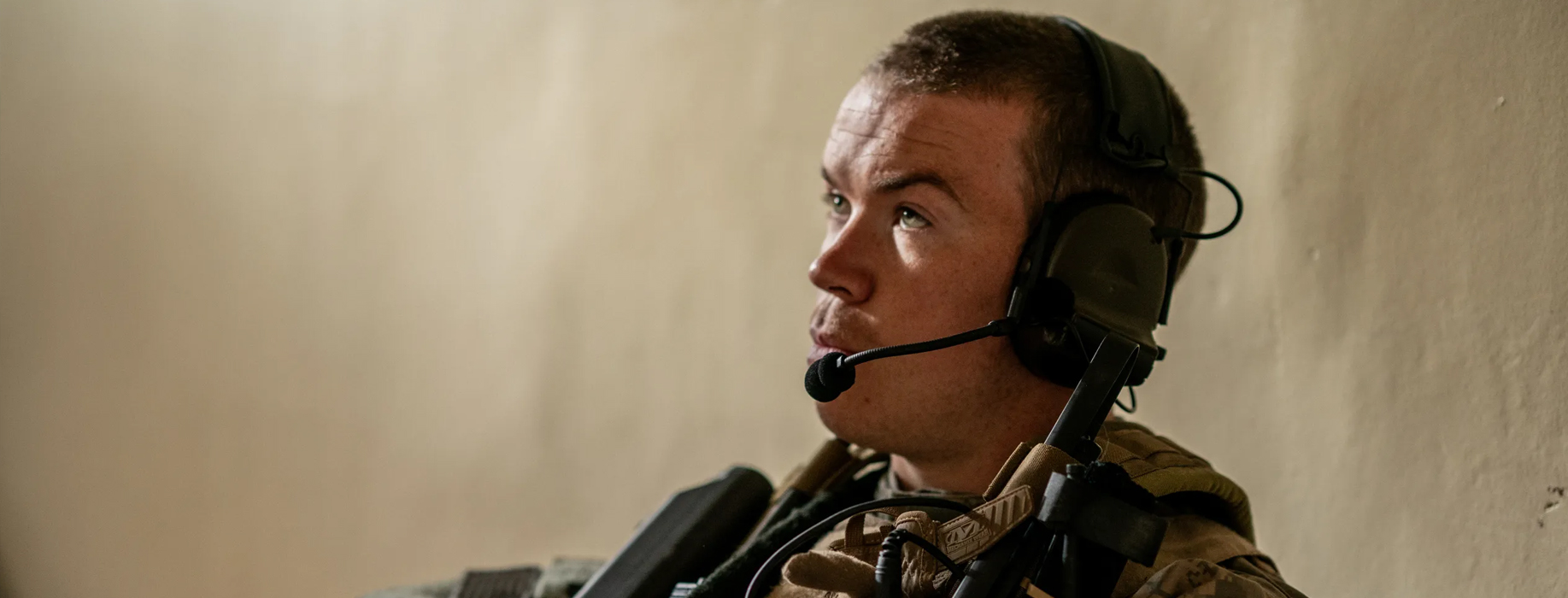
Will Poulter is the film’s quiet pressure point. He plays leadership not as confidence but as burden, a man constantly weighing options that all feel wrong. There’s no cinematic bravado in his performance, just clipped commands, second-guessing glances, and the sense that every order costs him sleep he’ll never get back. Poulter understands that real authority in combat isn’t loud. It’s isolating. Surrounded by people yet emotionally alone, he absorbs the unit’s fear and funnels it into decisions that have to be made immediately, even when certainty is impossible. That restraint makes his performance feel unnervingly authentic and deepens the film’s overall sense of realism, reminding us that the scariest part of war isn’t chaos. It’s responsibility.
Garland’s direction favors immersion over spectacle, and the sound design does heavy lifting. Radios crackle, commands overlap, and silence becomes its own threat. The score wisely stays out of the way, letting ambient noise do the emotional work. When things go quiet, it’s not relief. It’s dread.
That realism can also be a limitation. Viewers looking for narrative momentum or thematic hand-holding may find Warfare punishingly opaque. It doesn’t explain itself, and it certainly doesn’t comfort us. But that’s also why it works. This movie doesn’t feel real because it’s graphic. It feels real because it’s indifferent. And that indifference lingers long after the screen goes black.
RHFC Rating: 9/10 🍿