
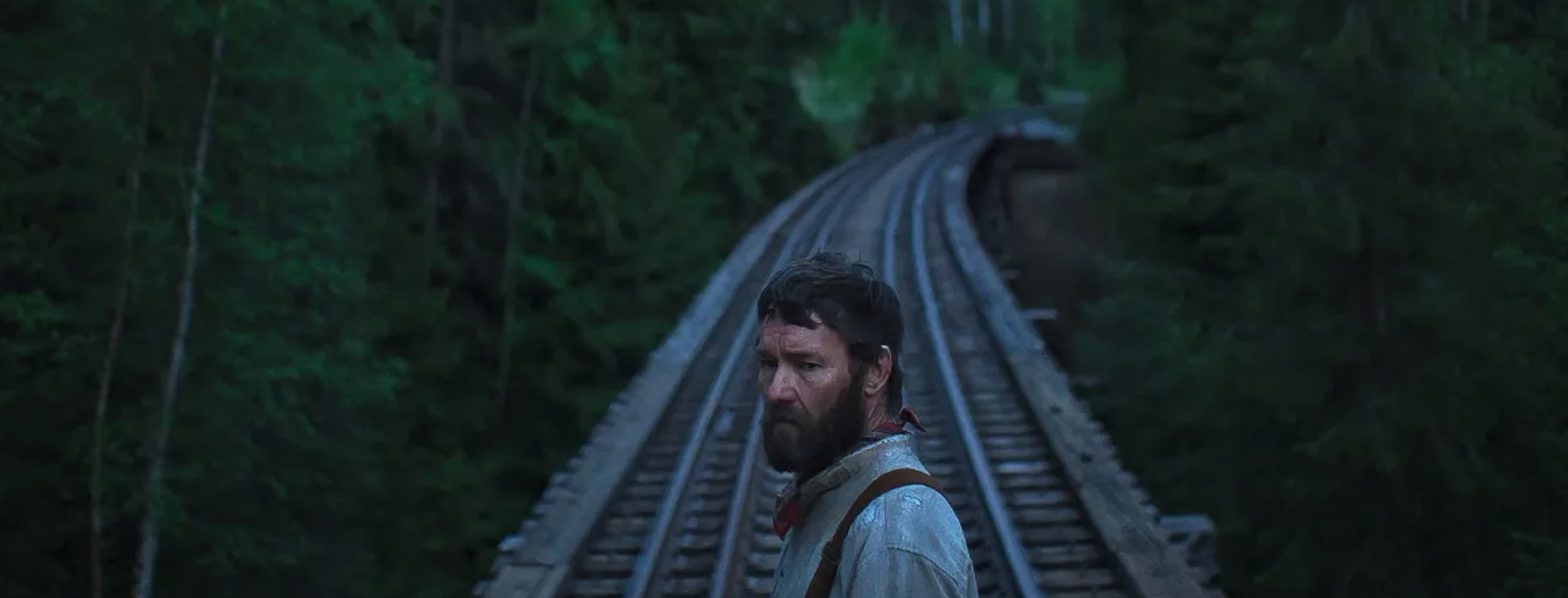
Clint Bentley’s Train Dreams is a beautiful frontier film that behaves like a mind trying to remember itself. Joel Edgerton’s Robert Grainier moves through the American West as a man quietly fractured by time, loss, and memory. What’s unexpected is how closely the film mirrors A Beautiful Mind in spirit. Not in plot, but in structure. Like John Nash, Grainier experiences a life filtered through interior visions that feel emotionally true even when reality wobbles. The film invites us to sit inside his perception rather than stand outside judging it.
Bentley directs with restraint that borders on austerity. This is not the operatic masculinity of Legends of the Fall, though its generational sorrow echoes here. It lacks the bombast of Far and Away, but shares its fascination with labor and ambition. And where The Revenant uses brutality to force meaning, Train Dreams lets meaning seep in slowly, like water through timber.
The cinematography is breathtaking. Forests, rivers, and rail lines are framed with painterly patience, making the land feel less like a backdrop and more like an accomplice. You feel time passing in the light itself. The soundtrack, on the other hand, barely leaves a footprint. It exists, does its job, and exits without ceremony.
One of the film’s most important gestures is its acknowledgment of Chinese immigrant labor during westward expansion. Their presence is brief but consequential. By including them at all, the film quietly rejects the myth of the solitary pioneer and reminds us that the West was built by exploited hands history prefers not to remember.
If the film falters, it is in momentum. Its pacing can feel elusive, almost evasive. But that slipperiness suits a story about memory, grief, and the stories we tell ourselves to survive. Train Dreams is not trying to impress you. It’s trying to linger, and it succeeds.
RHFC Rating 9.5/10 🍿