The Smashing Machine (2025) is less a sports movie and more a bruised meditation on masculinity, addiction, and identity. Directed, written, edited, and produced by Benny Safdie, it’s clearly a personal work—a film that trades the feverish chaos of Uncut Gems for something slower, quieter, and infinitely heavier. Safdie doesn’t glorify the world of MMA; he observes it. Fights are often shot from a distance or through the cage, as if we’re intruding on something intimate and painful rather than thrilling. You feel every punch, but not because of the choreography—because of what those blows cost afterward.
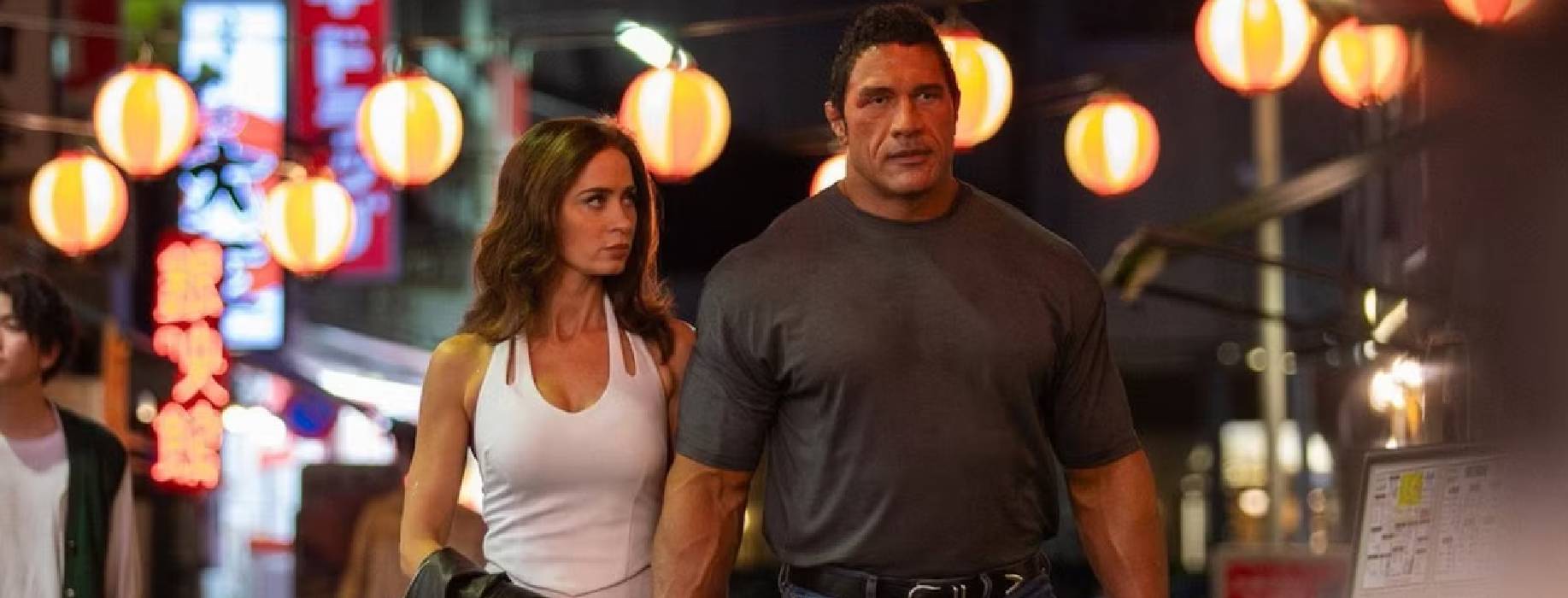
Dwayne Johnson gives what might be the most transformative performance of his career as real-life MMA fighter Mark Kerr. Under a mask of prosthetics (painstakingly applied in over twenty pieces a day), Johnson disappears completely, trading his usual charm for haunted restraint. His Kerr isn’t a conquering hero; he’s a man slowly crushed by his own myth. It’s a performance built on exhaustion and shame more than strength, and it’s mesmerizing to watch him shrink beneath the weight of his reputation. Emily Blunt, as Kerr’s volatile girlfriend Dawn Staples, injects raw electricity into every scene she’s in—though the film doesn’t give her quite enough space to develop beyond emotional chaos. Still, her presence grounds Johnson’s descent, offering fleeting glimpses of love amid the wreckage.
The film’s atmosphere is masterfully shaped by Nala Sinephro’s eerie score, which hums beneath the action like an open wound. The late-’90s MMA world is recreated with grimy precision—sweat, neon, and bad tattoos—but Safdie resists nostalgia. He’s less interested in the sport than in the silence after the roar. Yet, for all its control, the film sometimes falters in momentum. The middle act drags, lingering on emotional beats that feel half-formed. Safdie’s fidelity to the 2002 documentary of the same name occasionally works against him; some scenes feel like beautiful re-enactments rather than revelations.
Still, The Smashing Machine lands its emotional blows. It’s a film about self-destruction that never feels exploitative, about fame that corrodes from the inside out. Those expecting another Rocky or Warrior will find no rousing anthems here—just a quiet, painful honesty. Safdie’s direction is unflinching, and Johnson, stripped of his usual armor, delivers a career-defining knockout. It’s not a perfect film, but it’s a brave one.
RHFC Rating: 8.5/10 🍿