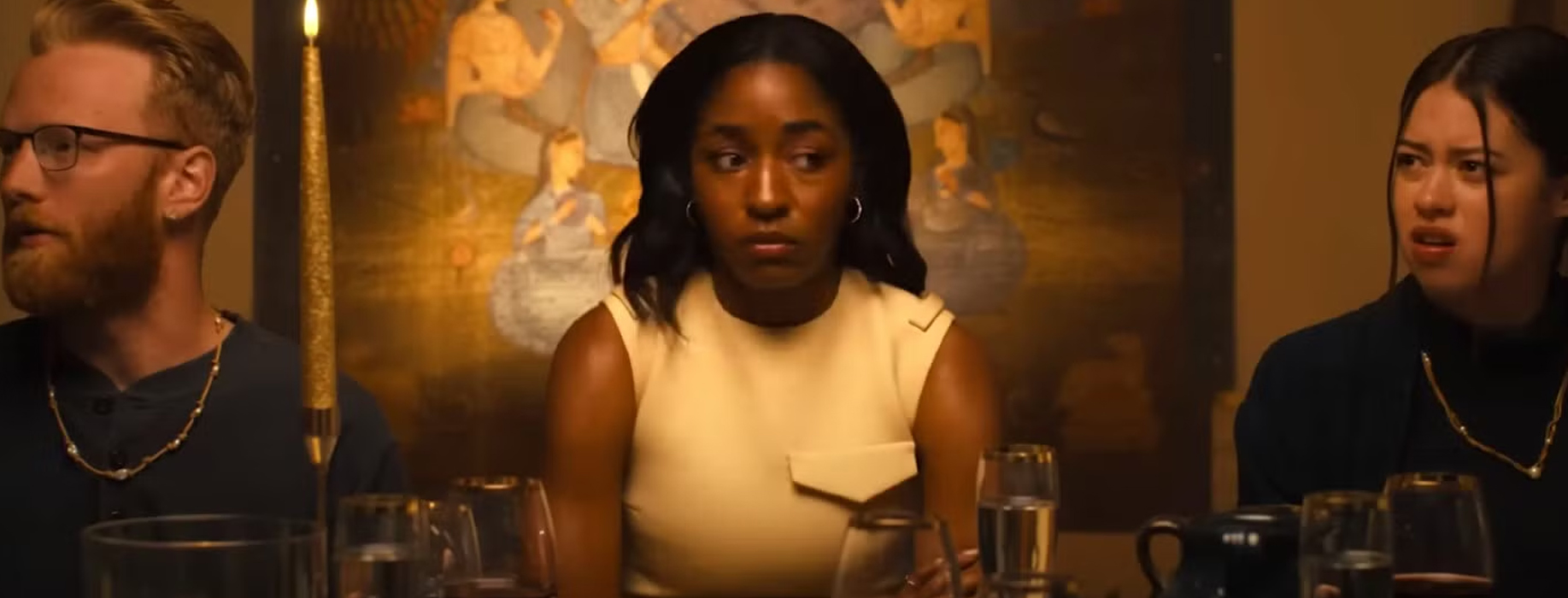
Directed by Mark Anthony Green, Opus is a psychological horror dressed up as prestige satire, the sort of film that smiles politely while rearranging your furniture when you are not looking.
Ayo Edebiri anchors the film as Ariel Ecton, a young journalist invited to an exclusive, deeply suspect retreat hosted by the reclusive pop icon Alfred Moretti, played with unnerving restraint by John Malkovich. Malkovich does not chew the scenery. He preserves it in formaldehyde. Every pause, every sideways glance feels calibrated to make us uneasy, like he knows the punchline to a joke we are still trying to decode.
Green’s direction leans heavily into atmosphere, ala Hereditary and Midsommar. Like Ari Aster, Green understands that true horror comes from control, not chaos. The camera lingers too long. The compositions feel ritualistic. The environments are sunlit, elegant, and quietly hostile. Much like Midsommar, the terror in Opus unfolds in plain sight, without the mercy of darkness to hide behind. And like Hereditary, the film trades jump scares for a creeping sense that something has already gone terribly wrong and there is no undoing it.
Where Opus distinguishes itself is in its cultural commentary. This is a film about power, celebrity, and the way creative genius can be weaponized into something cult-like. Green skewers media access, artistic worship, and the hunger to be included, all while letting the horror simmer beneath the surface.
At the end of the day, Opus is confident, unsettling, and deeply self-assured. It is not trying to scare you into submission. It wants you to notice the trap, admire the craftsmanship, and step into it anyway.
RHFC Rating: 8/10 🍿